An unexpected visitor from another star system barrelling unannounced through our inner Solar System inevitably sparks great interest, and no shortage of speculation.
The third such interstellar object ever discovered, 3I/ATLAS is no exception.
Despite claims that 3I/ATLAS may be an alien spaceship, a growing body of observations reveals that 3I/ATLAS is a natural comet, not a probe from a distant corner of the Milky Way, and here is the evidence that confirms it.
Observations of 3I/ATLAS, including those from Gemini South, as part of the NOIRLab educational observing program, have revealed a clear coma and tail: telltale features of a true comet.
These are not cosmetic flares or tricks of the light due to problems with the observations.
They’re physical manifestations of volatile materials – gases and water molecules – vaporising under increased heating from the Sun as the comet moves into the inner Solar System.
Comets contain ices such as water, carbon dioxide and ammonia.
As they approach the Sun, these ices sublimate – they turn from solid form into a gas – carrying dust with them and forming the glowing coma and sweeping tail.
Even a glance at its tail distinguishes 3I/ATLAS from an asteroid, which would lack these icy features.
A comet’s natural journey through space
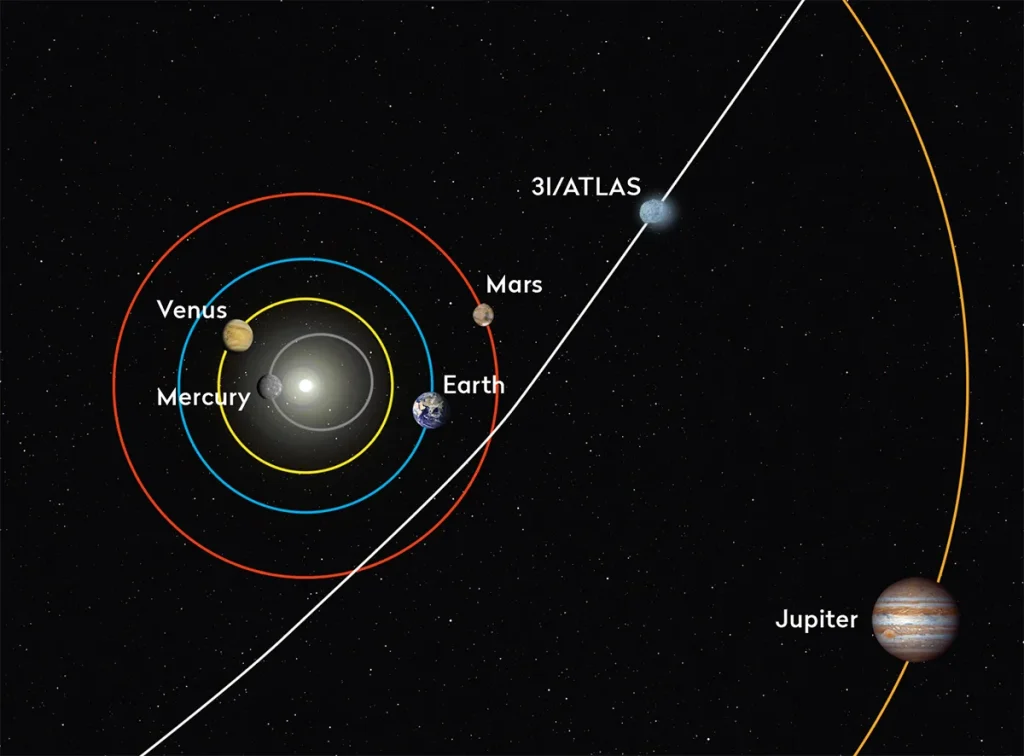
Beyond its appearance, 3I/ATLAS also behaves like a comet, with its trajectory showing no sign of non-gravitational forces.
For example, there’s no thrust, no course changes, just the simple motion governed by 3I/ATLAS’s initial trajectory and the Sun’s gravity.
If this were an artificial probe designed by intelligence like ours, we would expect to see the object clearly, not obscured by a coma of dust and ices, and it would also likely veer much closer to planets.
Instead, 3I/ATLAS is simply coasting through space, reflecting sunlight as it passes by, just as a natural object would.
Chemical fingerprints reveal its composition
3I/ATLAS’s chemistry tells us the same story.
Spectroscopy is an astronomer’s most powerful tool to learn vital information about everything in space, from distant galaxies to the building blocks of planets.
This technique helps further prove that 3I/ATLAS has no links to aliens.
Recent Very Large Telescope (VLT) observations of 3I/ATLAS detected molecules familiar from comets that originated within our Solar System.
While the chemical mix in 3I/ATLAS is slightly different, these variations likely reflect the tantalizing differences in the environment and chemical composition of its home star system compared to ours, not evidence of alien engineering.
A look into another Solar System
These findings tell us that 3I/ATLAS is a natural comet, not an alien probe, and that makes it an invaluable opportunity for science.
It offers a rare glimpse into the chemistry of the outer regions of another star system.
By comparing its composition to our own comets, astronomers can use it to test our models of how the outer regions of star systems form.
So, they can test whether our Solar System is typical or unique among the hundreds of billions of stars in our galaxy.
If so, it formed around a star born long before our Sun, at a time when fewer generations of stars had lived and died, and as a result, the galaxy was less enriched in heavy elements than it is today.
As a result, we might expect 3I/ATLAS to contain lower amounts of some of the heavier elements found in comets from our own solar system.
By studying this ancient interstellar visitor, we can unlock insights into the early Galaxy and make the most of this rare opportunity, without needing to invoke aliens or other exotic explanations.
Nature’s interstellar surprise
Every observation so far points to 3I/ATLAS being a natural comet, an ancient object from another star, not an alien visitor.
It reminds us that every interstellar comet offers a valuable window into another corner of the galaxy.